
Marriage Law and Paperwork in Northern Ireland: What You Actually Need to Know
Marriage law and paperwork
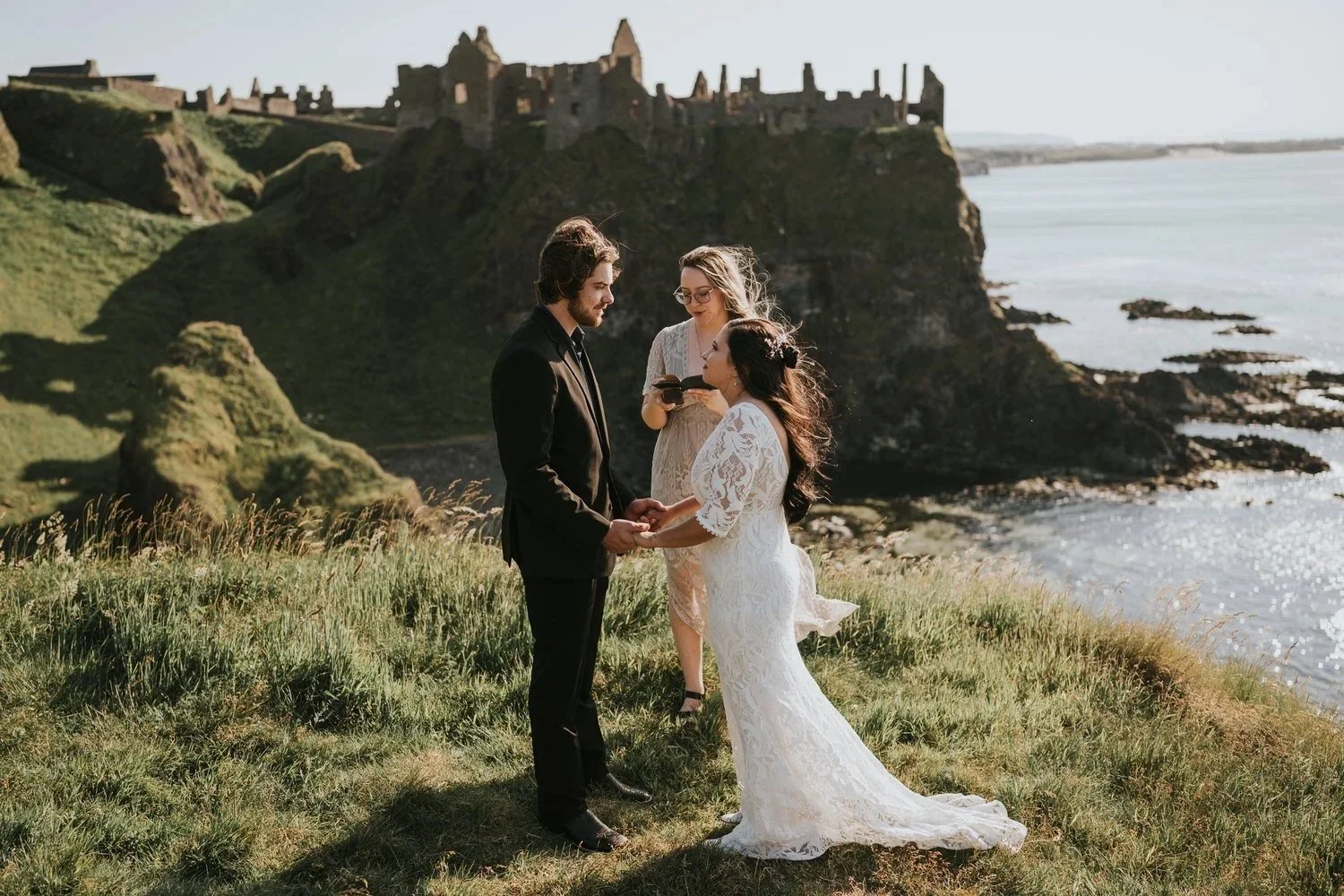
Between choosing a venue, a dress, and a photographer, it is easy for the actual legal side of getting married to slip down the list. That applies just as much if you're planning an elopement somewhere like Dunluce Castle as it does for a full wedding day, since the legal requirements are exactly the same either way. But the paperwork is not optional, and it has strict timing attached to it, so it is worth understanding early rather than discovering a deadline problem a few weeks before your wedding.
We have stood behind the camera at hundreds of weddings and elopements across Northern Ireland since 2014, and the legal side of things is something almost every couple asks us about at some point, usually somewhere between booking the venue and picking the invitations. We are wedding photographers, not solicitors, so nothing here replaces advice from your own registrar, but this is what we have picked up along the way, checked directly against nidirect's marriage guidance and current district council pages.
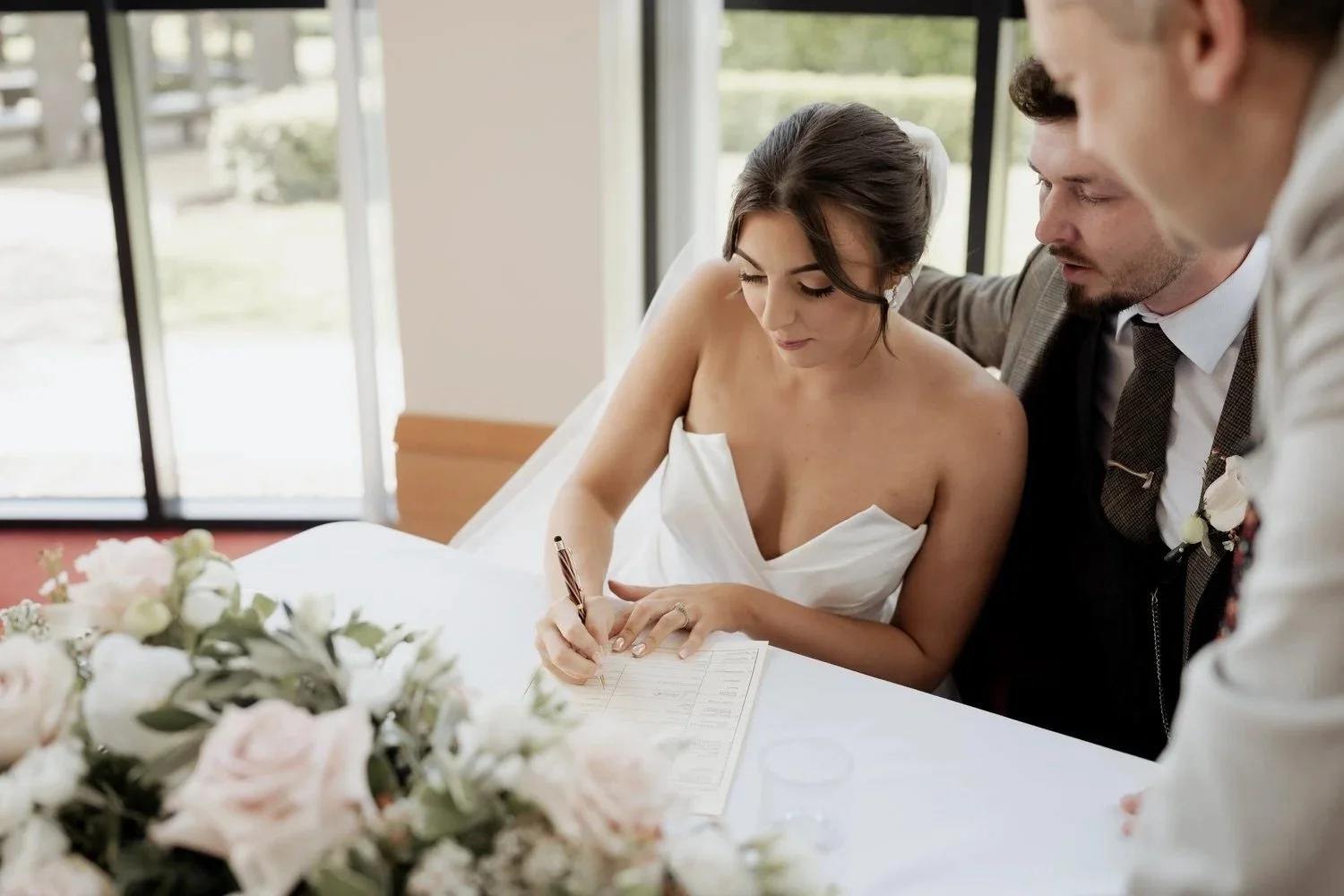
The timings at a glance
Before the wedding
Giving notice of marriage
Before you can legally marry in Northern Ireland, both of you must give notice to the registrar for the district where your marriage will take place. This applies whether you are having a civil, religious, or belief ceremony. You must give notice no later than 28 days before your wedding date, and you can give notice as much as twelve months in advance. In practice, most councils recommend giving notice around eight to twelve weeks before the day, which gives everyone breathing room in case anything needs sorted with your documents. It is worth pairing this with your photography plans too, since when to book a wedding photographer works on a similar principle, the earlier you sort the paperwork side, the less you have to think about later on.
Each person completes their own notice form, known as the GRO 446, so you will need two separate forms between you rather than one joint one. These can usually be submitted in person, by post, or by email depending on the district, so it is worth checking your own council's preferred method. Once your notice has been submitted, an objection to the marriage can technically be lodged with the registrar at any point between then and the wedding itself, though in practice this is rare and mainly exists to catch genuine legal impediments rather than to cause couples concern.
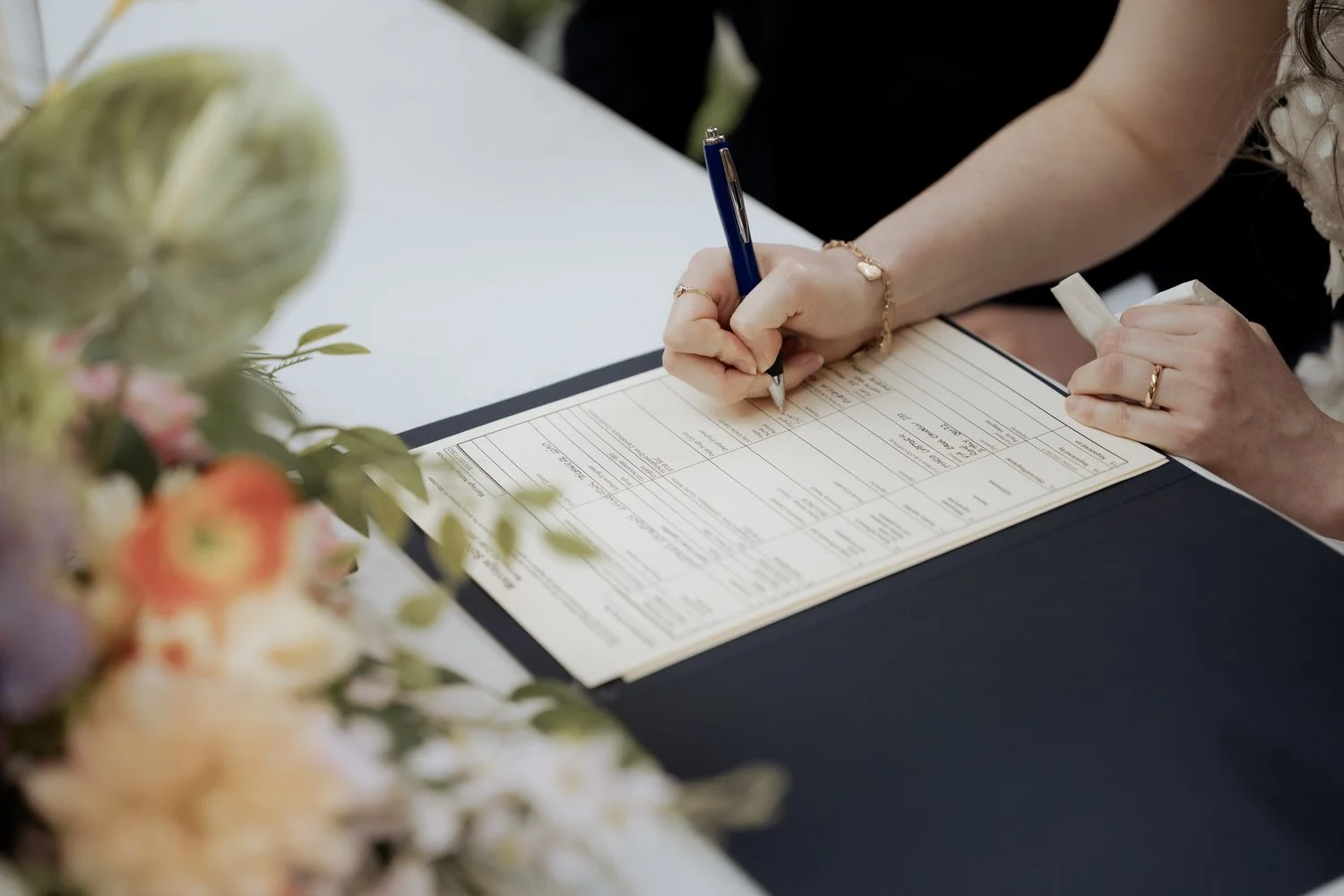
Before the wedding
The legal documents you will need
When you give notice, you will need to bring original documents, not photocopies, and if any are not in English they need a certified translation. Typically this means a full birth certificate showing your parents' details, and a passport or national identity card. If you have been married before, you will also need to show a decree absolute if divorced, or a death certificate if widowed, before the registrar can confirm you are free to marry.
Before the wedding
The fees involved
At the time of writing, the standard notice fee at several district councils is twenty two pounds per person, meaning forty four pounds between you for a straightforward notice. A copy of your marriage certificate is typically an additional eight pounds, payable when you collect your Marriage Schedule, bringing a religious or belief marriage to around fifty two pounds in total before any venue or officiant costs. Ceremony fees on top of this vary more widely, since they depend on your council, the day of the week, and whether you marry at a registrar's office or an approved venue. As an example, one district charges eighty eight pounds for a weekday ceremony at the registrar's office, rising to two hundred and fourteen pounds on a Saturday, with a temporary licence for an approved venue costing an additional four hundred pounds. Another district may charge differently, so these figures are illustrative rather than fixed.
These are all figures at the time of writing and councils do review and change them periodically, so treat everything above as a guide rather than a quote. Always check the current fees directly with the registrar for your own district before you budget or book anything.
Eligibility
Who can legally marry?
Eligibility is usually the first thing to check. Under current law, you and your partner must be eighteen or over on the day of your wedding, unrelated in a way that would prevent marriage, free to marry, and capable of understanding and consenting to the marriage. At present, sixteen and seventeen year olds can still marry with parental or equivalent consent, although this is changing. A Bill to raise the minimum marriage age to eighteen with no exceptions, and to remove the parental consent route entirely, passed its Second Stage in the Assembly in April 2026 and could become law before the end of the year. If this applies to your situation, it is worth checking the current position directly with nidirect closer to your date, since the law may have moved on by the time you read this.
Eligibility
Who can legally marry you in Northern Ireland?
Eligibility to marry is only half the picture, the person conducting your ceremony also has to be legally entitled to do so. For a civil ceremony, this must be a registrar or deputy registrar for the district in which the wedding is taking place. For a religious ceremony, your officiant must be recognised as a fit and proper person by their religious body, be over the age of twenty one, and be formally registered as an officiant before they are permitted to conduct any marriage.
For a belief, or humanist, ceremony, the same applies, your celebrant needs to be registered as an officiant through one of Northern Ireland's recognised humanist organisations rather than simply being someone you know who shares your outlook. If you are having a religious or belief ceremony with a celebrant who is newer to the role, it is worth confirming their officiant registration directly, since a marriage conducted by someone who is not properly registered is not legally valid. For more on weighing up these options, our guide on how to choose a wedding celebrant in Northern Ireland covers the practical side of picking between them.
On the day
Collecting your Marriage Schedule
Once your notice period has passed, you will need to collect your Marriage Schedule from the registrar's office in person. This cannot be collected any earlier than fourteen days before your wedding date, so it is not something you can tick off too far in advance. Your officiant cannot legally conduct your ceremony without it. Immediately after your ceremony, the schedule needs to be signed by both of you, two witnesses over the age of sixteen, and your officiant, and then returned to the registrar's office within three working days, at which point your marriage is formally registered.
On the day
Civil, religious, and belief ceremonies
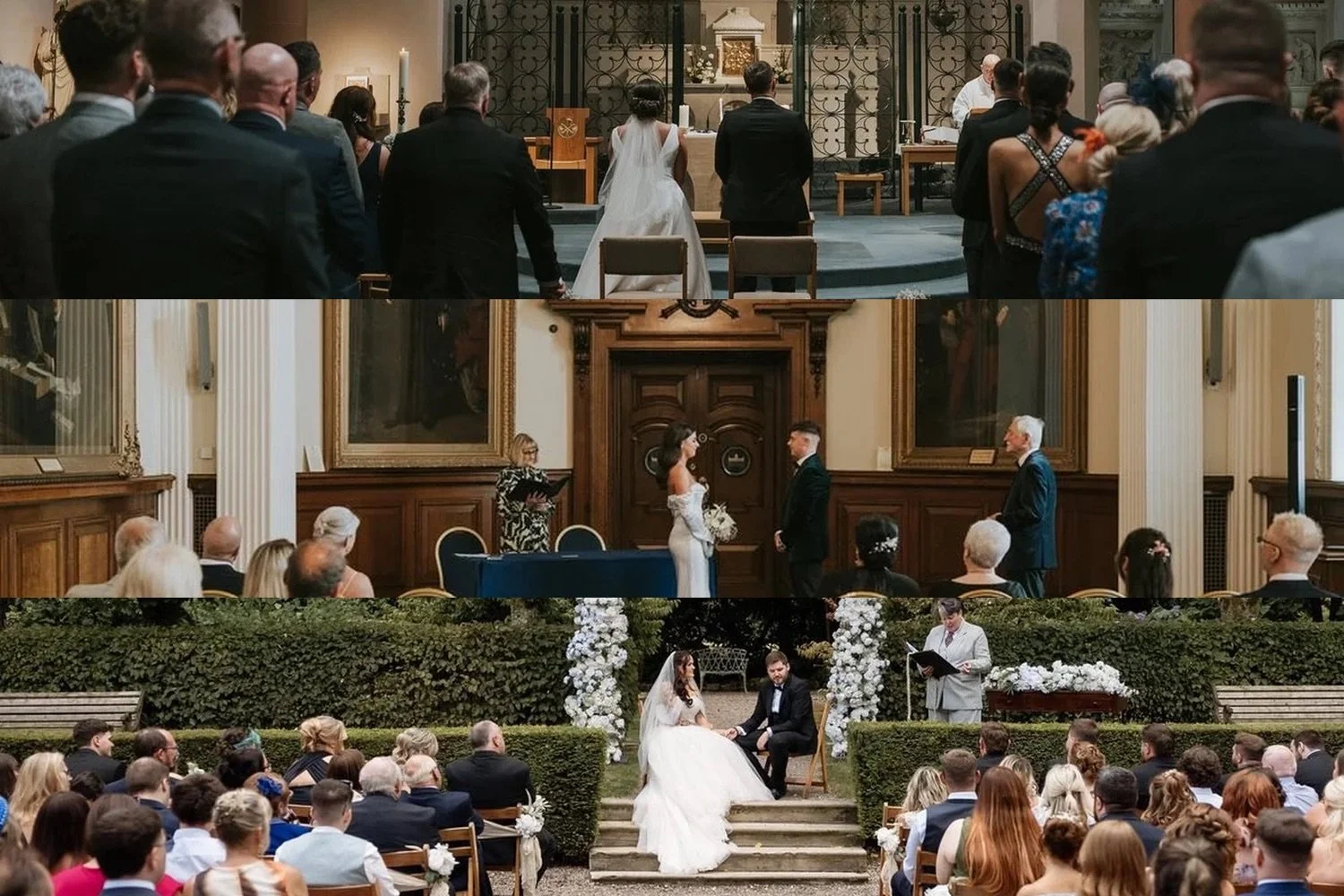
You have three routes to a legal marriage in Northern Ireland. A civil ceremony is conducted by a registrar, either at a registration office or an approved venue. A religious ceremony is conducted by an officiant recognised by your denomination, and anyone who wants to conduct a religious or belief marriage in Northern Ireland must themselves be registered as an officiant before they can legally do so, which is worth checking if you are having a celebrant marry you who is new to the role. Belief, or humanist, marriages have also been legally recognised for several years and now sit alongside religious marriages in terms of standing, with humanist ceremonies accounting for a meaningful share of Northern Ireland weddings each year. All three routes are worth knowing about if you are considering elopements in Northern Ireland, since a smaller or more intimate ceremony still needs to go through exactly the same legal steps as a full wedding.
Visiting
If you are visiting from outside Northern Ireland
If either of you is travelling from outside the UK to marry here, you will need the correct visa before you travel and before you give notice, and non EEA, UK, or Swiss nationals will also need to complete an immigration status statement as part of the process.
This is worth reading alongside our guide to elopements versus a traditional wedding in Northern Ireland if you are one of the many couples eloping to Northern Ireland from further afield.
Afterwards
After the wedding
Once your Marriage Schedule has been returned and your marriage registered, you can order additional certified copies of your marriage certificate online through the General Register Office for Northern Ireland whenever you need them, whether that is for changing your name, updating accounts, or simply keeping a copy somewhere safe.
Keep it current
Where to go for the most current information
Because fees and legal age requirements can change, always check nidirect and your own district council's registration office pages before you finalise your plans, particularly if your wedding is more than a few months away. Once your legal paperwork is sorted, the fun part starts. Have a look at our wedding photography packages whenever you are ready, or get in touch and we are always happy to help you plan the day around it.
Keep reading
More articles you might find helpful
If you are in the middle of planning your wedding you might also find these articles helpful.
Between choosing a venue, a dress, and a photographer, it is easy for the actual legal side of getting married to slip down the list. That applies just as much if you're planning an elopement somewhere like Dunluce Castle as it does for a full wedding day, since the legal requirements are exactly the same either way. But the paperwork is not optional, and it has strict timing attached to it, so it is worth understanding early rather than discovering a deadline problem a few weeks before your wedding.

We have stood behind the camera at hundreds of weddings and elopements across Northern Ireland since 2014, and the legal side of things is something almost every couple asks us about at some point, usually somewhere between booking the venue and picking the invitations. We are wedding photographers, not solicitors, so nothing here replaces advice from your own registrar, but this is what we have picked up along the way, checked directly against nidirect's marriage guidance and current district council pages.
Giving notice of marriage
Before you can legally marry in Northern Ireland, both of you must give notice to the registrar for the district where your marriage will take place. This applies whether you are having a civil, religious, or belief ceremony. You must give notice no later than 28 days before your wedding date, and you can give notice as much as twelve months in advance. In practice, most councils recommend giving notice around eight to twelve weeks before the day, which gives everyone breathing room in case anything needs sorted with your documents. It is worth pairing this with your photography plans too, since when to book a wedding photographer works on a similar principle, the earlier you sort the paperwork side, the less you have to think about later on.

Each person completes their own notice form, known as the GRO 446, so you will need two separate forms between you rather than one joint one. These can usually be submitted in person, by post, or by email depending on the district, so it is worth checking your own council's preferred method. Once your notice has been submitted, an objection to the marriage can technically be lodged with the registrar at any point between then and the wedding itself, though in practice this is rare and mainly exists to catch genuine legal impediments rather than to cause couples concern.
The legal documents you will need
When you give notice, you will need to bring original documents, not photocopies, and if any are not in English they need a certified translation. Typically this means a full birth certificate showing your parents' details, and a passport or national identity card. If you have been married before, you will also need to show a decree absolute if divorced, or a death certificate if widowed, before the registrar can confirm you are free to marry.
The fees involved
At the time of writing, the standard notice fee at several district councils is twenty two pounds per person, meaning forty four pounds between you for a straightforward notice. A copy of your marriage certificate is typically an additional eight pounds, payable when you collect your Marriage Schedule, bringing a religious or belief marriage to around fifty two pounds in total before any venue or officiant costs. Ceremony fees on top of this vary more widely, since they depend on your council, the day of the week, and whether you marry at a registrar's office or an approved venue. As an example, one district charges eighty eight pounds for a weekday ceremony at the registrar's office, rising to two hundred and fourteen pounds on a Saturday, with a temporary licence for an approved venue costing an additional four hundred pounds. Another district may charge differently, so these figures are illustrative rather than fixed.
These are all figures at the time of writing and councils do review and change them periodically, so treat everything above as a guide rather than a quote. Always check the current fees directly with the registrar for your own district before you budget or book anything.
Who can legally marry?
Eligibility is usually the first thing to check. Under current law, you and your partner must be eighteen or over on the day of your wedding, unrelated in a way that would prevent marriage, free to marry, and capable of understanding and consenting to the marriage. At present, sixteen and seventeen year olds can still marry with parental or equivalent consent, although this is changing. A Bill to raise the minimum marriage age to eighteen with no exceptions, and to remove the parental consent route entirely, passed its Second Stage in the Assembly in April 2026 and could become law before the end of the year. If this applies to your situation, it is worth checking the current position directly with nidirect closer to your date, since the law may have moved on by the time you read this.
Who can legally marry you in Northern Ireland?
Eligibility to marry is only half the picture, the person conducting your ceremony also has to be legally entitled to do so. For a civil ceremony, this must be a registrar or deputy registrar for the district in which the wedding is taking place. For a religious ceremony, your officiant must be recognised as a fit and proper person by their religious body, be over the age of twenty one, and be formally registered as an officiant before they are permitted to conduct any marriage.

For a belief, or humanist, ceremony, the same applies, your celebrant needs to be registered as an officiant through one of Northern Ireland's recognised humanist organisations rather than simply being someone you know who shares your outlook. If you are having a religious or belief ceremony with a celebrant who is newer to the role, it is worth confirming their officiant registration directly, since a marriage conducted by someone who is not properly registered is not legally valid. For more on weighing up these options, our guide on how to choose a wedding celebrant in Northern Ireland covers the practical side of picking between them.
Collecting your Marriage Schedule
Once your notice period has passed, you will need to collect your Marriage Schedule from the registrar's office in person. This cannot be collected any earlier than fourteen days before your wedding date, so it is not something you can tick off too far in advance. Your officiant cannot legally conduct your ceremony without it. Immediately after your ceremony, the schedule needs to be signed by both of you, two witnesses over the age of sixteen, and your officiant, and then returned to the registrar's office within three working days, at which point your marriage is formally registered.
Civil, religious, and belief ceremonies
You have three routes to a legal marriage in Northern Ireland. A civil ceremony is conducted by a registrar, either at a registration office or an approved venue. A religious ceremony is conducted by an officiant recognised by your denomination, and anyone who wants to conduct a religious or belief marriage in Northern Ireland must themselves be registered as an officiant before they can legally do so, which is worth checking if you are having a celebrant marry you who is new to the role. Belief, or humanist, marriages have also been legally recognised for several years and now sit alongside religious marriages in terms of standing, with humanist ceremonies accounting for a meaningful share of Northern Ireland weddings each year. All three routes are worth knowing about if you are considering elopements in Northern Ireland, since a smaller or more intimate ceremony still needs to go through exactly the same legal steps as a full wedding.
If you are visiting from outside Northern Ireland
If either of you is travelling from outside the UK to marry here, you will need the correct visa before you travel and before you give notice, and non EEA, UK, or Swiss nationals will also need to complete an immigration status statement as part of the process.

This is worth reading alongside our guide to elopements versus a traditional wedding in Northern Ireland if you are one of the many couples eloping to Northern Ireland from further afield.
After the wedding
Once your Marriage Schedule has been returned and your marriage registered, you can order additional certified copies of your marriage certificate online through the General Register Office for Northern Ireland whenever you need them, whether that is for changing your name, updating accounts, or simply keeping a copy somewhere safe.

Where to go for the most current information
Because fees and legal age requirements can change, always check nidirect and your own district council's registration office pages before you finalise your plans, particularly if your wedding is more than a few months away. Once your legal paperwork is sorted, the fun part starts. Have a look at our wedding photography packages whenever you are ready, or get in touch and we are always happy to help you plan the day around it.
If you are in the middle of planning your wedding you might also find these articles helpful.
WHAT IS A HANDFASTING CEREMONY?
BEST WEDDING VENUES IN NORTHERN IRELAND
PRO’S AND CON’S OF NORTHERN IRELAND’S MOST POPULAR WEDDING VENUES
HOW TO CHOOSE PHOTOS FOR YOUR WEDDING ALBUM
AWARD WINNING NORTHERN IRELAND WEDDING PHOTOGRAPHER
ULTIMATE GUIDE TO BRINGING YOUR DOG TO YOUR NORTHERN IRELAND WEDDING
WHAT ARE THE DIFFERENT TYPES OF WEDDING PHOTOGRAPHERS IN NORTHERN IRELAND?
DO I NEED WEDDING PREP PHOTOS?
DO WEDDING PHOTOGRAPHERS EDIT ALL PHOTOS?
HOW MANY WEDDING PHOTOS SHOULD I GET?
BEST PLACES FOR ENGAGEMENT PHOTOS NORTHERN IRELAND
WEDDING PHOTOGRAPHER IN BELFAST