
Essential Wedding Photography Gear Guide: Must-Haves for Every Shot
This is a question we get asked a lot by other photographers, barely a week goes by without us receiving messages on social media or getting contacted by email with questions about equipment. We get a lot of messages like this on Instagram in particular, usually asking what equipment we used to take a particular photograph.
These are mainly newbie photographers trying to find their way. Most experienced photographers know that the craft and knowledge involved in using camera gear is much more important than the equipment itself.

An often used saying in photography is that newbie photographers talk about cameras, amateur photographers talk about lenses and experienced photographers talk about lighting and technique. This is sort of true, but we know that even with experienced photographers, if you get a few of them together there will be lots of talk about gear. We all love our shiny new toys! It is also very true to say that a skilled photographer can create wonderful images even with the most basic of equipment. When it comes to working professionally though there are other things to consider especially when it comes to wedding photography.
Camera equipment for a wedding is definitely more important than it is for someone buying a camera to take a few photos of their kids and for every day use. The equipment needs to be able to perform in often difficult lighting situations, it needs to be reliable and suitable for use for a range of many different photography genres. This is one of the things we love about photographing a wedding, on any given wedding day we are not just a wedding photographer, we are a portrait photographer, a product photographer, a landscape photographer and a photo journalist all rolled into one.
Clients 99% of the time don’t care about what equipment we use and we have only ever had a handful of clients ask us gear related questions and that was because they were interested in photography or they worked as a professional photographer themselves.
It is actually a difficult question for us to answer as our needs will be different than other photographers. Wedding photography equipment requirements are determined by shooting style and because there are two of us that also makes a difference as well.
We have a lot of camera equipment, much more than we need to photograph most weddings and there won’t be many Northern Ireland wedding photographers that have as much equipment as we do. This is because we like to be prepared for any situation, we also prefer to have lots of back up equipment at hand just in case something develops a fault while we are working. Over the years at times equipment has failed but our clients have never been aware of it as we have been able to just switch over to our back up equipment and proceed as normal, just as it should be. We feel this is an important part of delivering excellent service to our clients.
There is a temptation as a wedding photographer to keep equipment to the bare minimum, camera equipment can be very expensive and professional equipment can be heavy and cumbersome to have to carry around all day. This is a route we decided not to go down though for the reasons mentioned above.

This is a list of most of the equipment we have at the moment, although we have probably forgotten loads of stuff.
Camera Bodies
2 X Sony A9
4 X Sony A7III
Prime Lenses
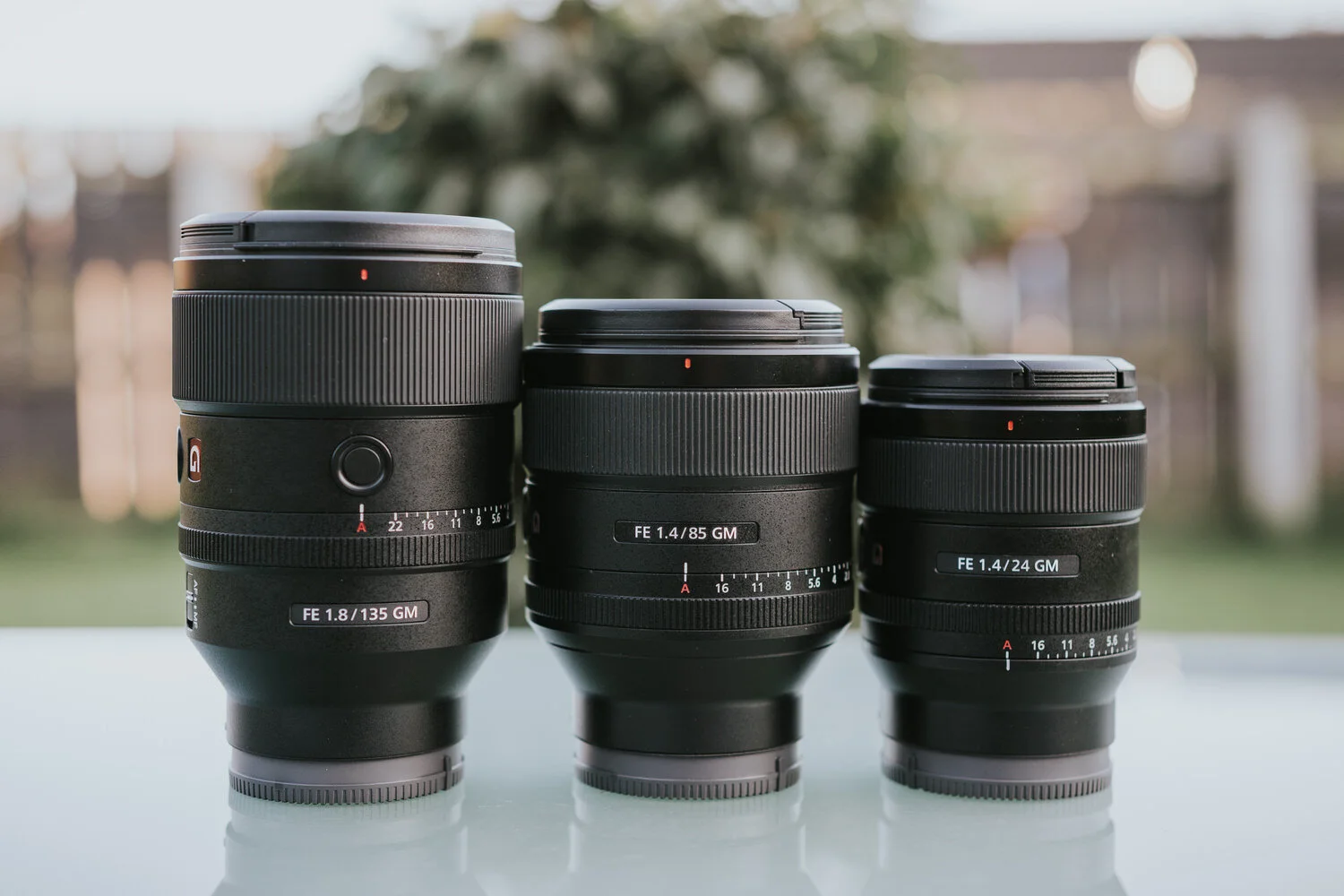
Sony 24mm f/1.4 GM
Sony 35mm f/1.8
Sigma Art 35mm f/1.4
Samyang 45mm f/1.8
Sony 55mm f/1.8
Sony 85mmm f/1.8
Sony 85mm f/1.4 GM
Sony 90mm Macro f/2.8
Sony 135mm f/1.8 GM
Zoom lenses
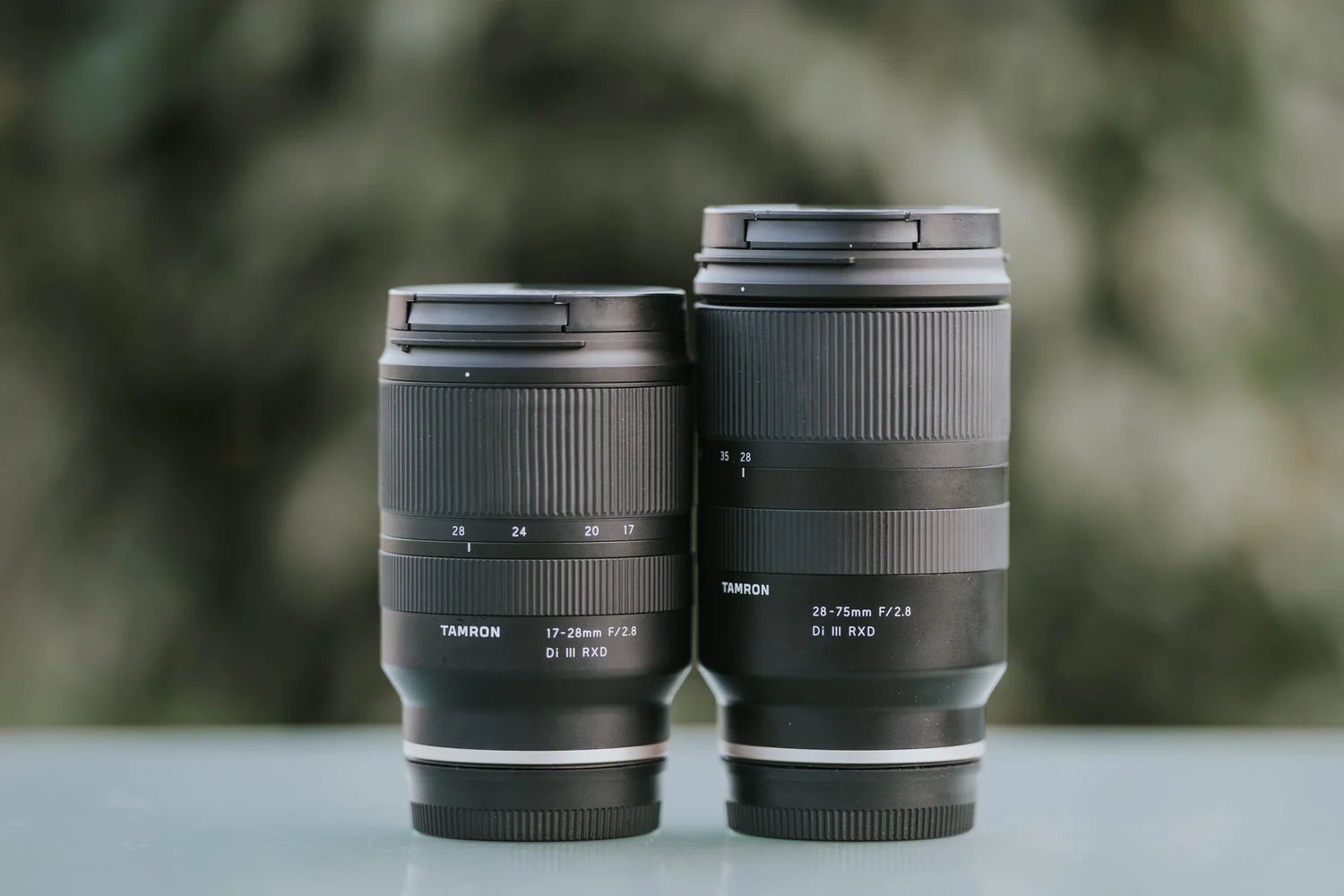
Tamron 17-28mm f/2.8
Tamron 28-75mm f/2.8
Sony 200-600mm f/5.6-f/6.3
Lighting
4 x Godox v350S flashguns
2 x Godox AD200 off camera flashes
2 x Godox AD600 off camera flashes
4 x Godox flash triggers
3 x Neewer L.E.D lights
Interfit studio lighting system
Accessories
Spare batteries - we have a metric ton of these
Memory cards - we have too many to count
Camera bags – we have enough of these to open our own camera shop
6 x Peak Design Slide camera straps
4 x Peak Design Cuff camera wrist straps
Tripods
Reflectors
Various light stands, modifiers and other lighting accessories
Plus, loads of other little bits and bobs that we use for a particular style of photograph, equipment for cleaning lenses, camera sensor cleaning equipment or little things that just make it easier for us to work.

Editing / Post Production equipment
We won’t bore you with all of the details but as you would expect we have multiple computers that we use with professional colour managed monitors designed for photo editing, various photo editing software packages, probably more hard drives and storage devices than your local computer store and we also use an online service for backing up photographs as well.
As you can see, we are well covered for pretty much any situation we would encounter at a wedding, but we don’t bring all of our equipment to every wedding. While clients won’t be aware of it, we like to meticulously plan our part of the wedding day so that we know what equipment we will need for each part of the day. We sit down before each wedding, work out what we will need then add what we will need as back up equipment in case something goes wrong and anything else left over stays at home.
Photography style determining equipment choice
Every photographer has their own style of shooting. We prefer using prime lenses as they better fit with the creative style we want from our photography. We will also usually have another body close by matched with a lens we may need for a specific photograph. Prime lenses also tend to be sharper, have more character and cope better in low light situations than zoom lenses. Other photographers might prefer zoom lenses as they are just easier to use, they are also much cheaper as one lens can cover the focal lengths of many others.
Because we prefer prime lenses, we always need to have at least two camera bodies on us at all times, one with a wide lens and one with a longer lens. Someone that mainly uses zoom lenses may only need to carry one camera body as their zoom lens will likely cover from a wide to a long focal length.
Because there is two of us our set up would be slightly different to others that work alone. Usually one of us will use a 35mm and 85mm combination, while the other uses a 24mm and 55mm combination. Most wedding photographers that mainly use prime lenses will use a 35mm and 85mm combination for the majority of the wedding day. Most wedding photographers that use zoom lenses will use a 24-70 or similar focal length lens for most of the day but have a 70-200mm lens near by in case they need something longer.
Those lenses will cover pretty much 90% of everything photographed at a typical wedding, with the exceptions being a macro lens for details shots and possibly a wide-angle lens for when there is limited space available.

Don’t choose a camera body, choose a camera system that best fits your needs
When you buy a high-end professional camera, you are not just buying a camera you are buying into a system and thought should be given to the lenses available, the compatible lighting available etc. We have used equipment from all of the popular brand names and Nikon was our preferred choice until a couple of years ago. We wanted to switch to a mirrorless camera system from our DSLR’s as autofocus is more reliable, the electronic viewfinder lets us see our exposure in real time, the equipment tends to be lighter and smaller, the silent shutter option is also a bonus and because they are newer with updated tech, image quality is better.
After considering all of the options available at the time. we switched to Sony as their newer mirrorless camera options are a great fit for wedding photography. They have the best auto focus available, the sensors also have amazing dynamic range, which is great for low light photography and all of their newest cameras have two card slots. Having two card slots was important to us as it means we always have a card back up if a memory card were to fail. Even now, Nikon don’t yet have a mirrorless camera with this option and Canon have only just recently launched models that do.
We would strongly advise buying a camera that has two card slots, when that option is available to you as a working professional, we feel it is complete negligence not to do so.
Why is lens selection and focal length important?
All lenses have different advantages and disadvantages, some are best used for a particular type of photograph while others are more general purpose. Lens choice and in particular the focal length you choose will create a different style of photograph and we base our choices on our needs for the different parts of the wedding day.
Equipment for the bride getting ready
At most weddings when we go to photograph the bride getting ready, our wider prime lenses like our 24mm and 35mm are the best choice. While being wide enough to capture both the subject and a little bit of the environment they are not too wide that they cause much distortion. On the morning of most weddings we are usually working indoors and there isn’t always a lot of available space available so those focal lengths suit best. During the morning we will also use our 90mm macro lens along with occasionally our l.e.d lights or a flash for details like jewellery etc. If the space available allows, we will also use our 55mm and 85mm lenses for photographs of the brides make up application and hair styling.
Equipment for the ceremony
Lens choice for the wedding ceremony is very much dependent on the type of venue, the space available and if any photography restrictions have been put in place by the wedding officiant. If it’s an outdoor ceremony we will usually use our 85mm and 135mm lenses as this allows us to stay well out of the way while still capturing everything, although we will grab a few shots using a wider lens like our 24mm as well. For a wedding inside a church or chapel we will mainly use our 24mm, 35mm, 55mm and 85mm lenses and occasionally our 135mm lens. We never use flash during the ceremony as it is too distracting.
Equipment for portraits after the ceremony
Usually after the ceremony we will head off with the bride and groom by themselves and we will mainly use our 85mm and 135mm lenses. Longer focal lengths when used for portraits have much better compression than wider focal lengths and the 85mm and 135mm lenses we use are the best available for this purpose. We will also grab a few shots using our 24mm and 35mm lenses depending on the location as the wider focal length will help us show more of the surrounding environment.
Once the session with the bride and groom has been completed, we will usually photograph the bridal party and grab a few family photos. For this part of the day we mainly use our 35mm and 55mm lenses. For smaller groupings and when we have the space available, we will sometimes also use our 85mm and 135mm lenses.
Usually these photographs will be taken outdoors and we rarely use flash. Instead we will direct our subjects into the best locations to make the most of the natural light available as this best fits our photography style. Occasionally of course that won’t be possible due to bad weather. When that happens and we need to move indoors, we will use our Godox AD200’s. These are off camera flashes, sometimes one of us will just hold the flash were needed or we will use a light stand. When we need to use these, we will often use a modifier like an umbrella or a beauty dish depending on the look we are going for. These provide much more flattering lighting for portraits than using a normal flash on camera, we hate that flash blasted look were the lighting is not controlled. These are also much more powerful than a normal flash. If we are very restricted for space and there is no other option, we will use our Godox V350S flashes on camera but rather than point them directly at our subjects we will bounce the light from the flash off a wall or the ceiling to create more dynamic lighting.
Equipment for the Speeches
When photographing the speeches equipment choice is again going to be determined by the amount of space available and the layout of the room. When we have enough space available, we will use our 85mm and 135mm lenses as this allows us to stay out of the way and melt in the background. When this isn’t possible, we will use a mixture of our 24mm, 35mm and 55mm lenses. We don’t use flash during the speeches so as not to cause a distraction to the speakers.
Some Northern Ireland wedding venues are notorious for turning down all available lighting in the room for the speeches and the meal to create “atmosphere”. When that happens, we will have a chat with the couple and ask them to speak to their contact in the venue and ask them to turn up the lights until the speeches have finished.
Equipment for the Dancing
For the couple’s first dance we are usually a little more restricted in terms of what we can do. Bands and D.J’s really dislike us setting up flashes on stands off camera as it can get in the way of their equipment. Many venues won’t allow us to do this anyway for health and safety reasons. So we tend to use our Godox V350S flashes on camera but we will bounce the light of a wall or the ceiling so that we don’t distract people on the dance floor by blasting them face on with a flash and we don’t get the flat lighting that you normally get when using a flash on camera.
In terms of lenses we will mainly use our wider lenses like our Tamron 17-28mm along with our Sony 24mm and 35mm. Using wider lenses for this part of the day allows us to both get close to the action while still capturing everything and most dance floor areas aren’t big enough to use longer focal lengths.
Back up equipment for weddings
As mentioned previously we both always carry two camera bodies each, but we always bring along at least one spare camera body in case one fails. In terms of lenses because 35mm and 85mm are the focal lengths we use the most we have two each of those. We also always bring along our 17-28mm and 28-75mm zoom lenses and treat those as our redundancy lenses. We could easily photograph a wedding using nothing but those if needed. We always have enough lighting equipment to allow for any equipment failure and in terms of accessories we always carry enough spares to do three weddings never mind one.

Do I need to spend tens of thousands of pounds on equipment to photograph a wedding?
The answer is no, we appreciate that our list of equipment could maybe look a little daunting to someone starting out in wedding photography. We are in the lucky position of having built up our equipment over many years. When we switched from Nikon to Sony, there was still quite a lot of value left in our old Nikon equipment when we traded it in. When we first started photographing weddings, we had a lot less equipment, although even for our very first ever wedding we made back up equipment a priority and we would strongly advise you to do the same.
If you are starting from scratch choose a system that suits your needs. If you are mainly a prime lens user like us the focal lengths needed to cover most wedding situation are from 18-85mm. So, buy lenses within that focal range. For example, if you were shooting Sony you could go for their excellent 35mm f/1.8 and 85mm f/1.8 and add a cheap wide-angle lens like the Samyang 18mm for the odd occasion you would need it. More specialised lenses like a 135mm portrait lenses or a macro lens can always be purchased later on. If you are a prime shooter though you will need two camera bodies as you won’t have time during a wedding to change lenses, and realistically a third as a backup.
If you are a zoom lens user you could purchase a mid-range zoom like a 24-70mm f/2.8 which will cover most wedding situations. You may also be able to get away with only 2 camera bodies as you will only be using the one lens at any time, with the other body being your backup. You will also need another lens as a backup and a cheap 50mm prime might just do the trick. In terms of things like batteries and memory cards you will need many of these. There will times when you won’t have time to charge up batteries etc before your next wedding as well as concerns around something having a fault.

Cost versus return
Wedding photography is a business and like any business costs have to be managed if you want to stay open. In a lot of cases with camera equipment the cost versus the return doesn’t always make financial sense. For example, most f/1.8 prime lenses these days are excellent and sometimes out perform their much more expensive f/1.4 equivalents. In terms of light gathering ability there is only a two third of a stop of difference between the two. In terms of cost though the f/1.4 lens will often be at least twice or even three times the cost. Most people wouldn’t be able to tell the difference between a photograph taken at f/1.4 versus a photograph taken at f/1.8. The same thing can also apply to camera bodies. For example, we use the Sony A9 and A7III, the A9 is a better camera in terms of autofocus capability and is best in class. The A7III is also extremely good in this respect but an A9 is more than double the cost of an A7III. The new Sony A9II has the same a.f capability as the A9, with the same sensor so produces the same quality images but has advanced networking capability aimed at sports photographers but is much more expensive than the A9 with no real advantages for a wedding photographer.
These are all things you will have to consider carefully especially if you are starting from scratch. With camera equipment you will sometimes find yourself spending two or three times as much to gain maybe an extra 5% better performance. You could say its easy for us to say that when we have all the best available gear but as we said above, we didn’t always.
Equipment professional service schemes and Insurance
As well as the cost of your equipment, service and insurance costs should also be considered. Most of the most popular camera manufacturers offer a professional services scheme and in the U.K this is usually free of charge. This is always worth signing up for. Most of the schemes offer enhanced service levels if you need to have a camera or lens repaired. This generally means that you get a much quicker turnaround time on repairs and usually the option of receiving a loan piece of equipment while your camera or lens is in for repair. We are registered with both Nikon and Sony under their schemes. With Nikon the process was fairly simple we just had to register online and wait for them to confirm our details. With Sony the process was a little more involved, not only did we have to provide proof that we were a legitimate photography business we also had to send them a copy of the invoices for all of the equipment that we registered with them under the scheme. With the Sony Imaging Pro Support scheme as well as receiving much quicker repair times, the option of loan equipment if something needs to go in for repair, they also provide free camera sensor cleaning as well as things like fixed priced repairs.
There are many different insurance companies that offer camera equipment insurance. For professional photographers this is usually bundled in along with your public liability insurance and professional indemnity insurance. They all have different terms and conditions which should be read very carefully to ensure that you are covered for everything that would expect. Some insurers will offer a discounted rate if you are a member of a recognised trade association. Our insurer provides us with a discounted rate because we are members of the Society of Wedding & Portrait photographers.
How to save money when buying camera equipment
It would surprise you how many photographers buy equipment and lightly use it or sometimes don’t even use it all so the used market is a good option to pick up nearly new equipment at a reduced cost. When buying used equipment for professional use it is always better to buy from a recognised camera dealer. Not only will they provide you with warranty but they will also provide you with proof of purchase which is important for insurance reasons. If you need to make a claim on your equipment insurance the vast majority of insurers will require proof of purchase. For lower value items that you wouldn’t normally claim on your equipment insurance for there are lots of bargains to be found on online photography forums, eBay or even Facebook marketplace.
Hope this all proved helpful to those that contact us about equipment
If you read through all of this and your only take away is that back up equipment is important this blog post will have done its job well. We know a lot of wedding photographers and we know that not everyone is as careful as we are around this. We have always felt that as a professional it should be a given that these things should be in place, we think clients will automatically assume that it is. Unfortunately, this isn’t always what actually happens and while some photographers may be lucky enough to get away with it for a period of time, we have also heard lots of absolute horror stories that have meant that because there wasn’t backup equipment in place there were lots of issues when their equipment failed during clients weddings. We honestly believe that if you are not able to put these things in place that you shouldn’t be offering professional services as at some point you are going to really disappoint a client. If you don’t have the budget to do everything properly wait until you can. When you photograph someone’s wedding, they are relying on you to provide them with memories of one of the most important days of their lives, don’t let them down!
If you are at the start of the journey towards becoming a professional wedding photographer you might also find these articles helpful.
PHOTOGRAPHING KIDS AT WEDDINGS
BOOKING A WEDDING PHOTOGRAPHER
CANDID WEDDING PHOTOGRAPHER NORTHERN IRELAND
FAMILY AND BRIDAL PARTY GROUP PHOTOS AT WEDDINGS
WEDDING PHOTOGRAPHER LONDONDERRY
DO YOU THINK THAT WEDDING PHOTOGRAPHY IS EASY